Difference between revisions of "X-ray of the shoulder"
Jump to navigation
Jump to search
(→General screening: +AC) |
(→Normal anatomy: Avoided Share-alike) |
||
| Line 7: | Line 7: | ||
File:Anteroposterior glenoid (Grashey view) X-ray of a normal shoulder.jpg|AP glenoid (Grashey view). | File:Anteroposterior glenoid (Grashey view) X-ray of a normal shoulder.jpg|AP glenoid (Grashey view). | ||
File:Transaxillary CR shoulder.jpg|alt=A Transaxillary conventional radiography|Transaxillary | File:Transaxillary CR shoulder.jpg|alt=A Transaxillary conventional radiography|Transaxillary | ||
| − | File:Y | + | File:Y-projection X-ray of a normal shoulder.jpg|alt=A Y-projection conventional radiography|Y-projection |
</gallery> | </gallery> | ||
Revision as of 13:36, 3 December 2018
Author:
Mikael Häggström [notes 1]
Normal anatomy

AP glenoid (Grashey view).
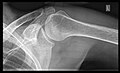
Transaxillary

Y-projection
_X-ray_of_a_normal_shoulder.jpg)


General screening
In emergent exams, exclude fractures (see X-ray of fractures) and misalignment.
Misalignment can be in the form of dislocation, while a superior movement of the humerus in the joint indicates a rotator cuff tear. Further reading:

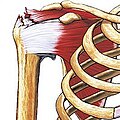
Non-emergent exams generally only need to answer the requests on the referral.
In case of findings in the acromioclavicular joint, consider specific X-ray of the acromioclavicular joint.
Shoulder replacement

Notes
- ↑ For a full list of contributors, see article history. Creators of images are attributed at the image description pages, seen by clicking on the images. See Radlines:Authorship for details.
