CT
Revision as of 21:46, 9 January 2019 by Mikael Häggström (talk | contribs) (→General planning: Specified thicknes)
Author:
Mikael Häggström [notes 1]
Contents
By location

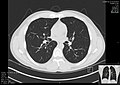

With contrast
General planning
Upon receiving a referral for a CT, generally check:
- Who is the ordering individual?
- Where: From which unit or department?
- Requested investigation
- Targets: Suspected diseases or other questions or requests
- Patient history
- Possible earlier imaging that can already answer the questions?
Consider if another modality is better for the questions at hand.
Choose the proper CT settings for optimal evaluation, including contrast CT or non-contrast.
Include thin slices (0.5 to 1.5 mm)[1] if the skeleton needs to be evaluated.
General post-imaging approach
- Check the order form
- Who is the ordering individual?
- Where: From which unit or department?
- Patient history
- Requested investigation
- Targets:
- Earlier investigations, and their findings
- Examine the images at hand, including:
- Requested targets from the referral, or suspected diseases or other questions
- Basic screening, whose targets vary with mainly anatomic location (see locations above), but broadly include:
- Soft tissues, mainly for tumors or other expansions such as hematomas (see CT of muscle hematoma)
- Skeleton, mainly for fractures (see CT of fractures and tumors (see CT of bone tumors).
- Complement with reconstructions where needed, such as volume renderings or thinner slices.
- Write report
- See also: General notes on reporting
- Check one extra time if the reply corresponds to the targets at hand.
Hounsfield scale
Notes
- ↑ For a full list of contributors, see article history. Creators of images are attributed at the image description pages, seen by clicking on the images. See Radlines:Authorship for details.
References
- ↑ Maetani, Kazuhide; Namiki, Jun; Matsumoto, Shokei; Matsunami, Katsutoshi; Narumi, Atsushi; Tsuneyoshi, Toshimi; Kishikawa, Masanobu (2016). "Routine Head Computed Tomography for Patients in the Emergency Room with Trauma Requires Both Thick- and Thin-Slice Images ". Emergency Medicine International 2016: 1–4. doi:. ISSN 2090-2840.
